check_circle error info report
local_mall 0
local_mall 0
Menopause & Hair An expert article by Dr Sarah Jenkins, GP
5 Reasons Your Hair Has Been Thinning Since the Menopause  and Why Nothing You've Bought Has Touched It
Dr Sarah Jenkins · GP with a special interest in menopause and women's hair loss · 21 years in practice, North London
I want to start with the sentence I hear most often in my clinic. It usually comes about four minutes in, once the woman opposite me has stopped pretending it isn't a big deal.

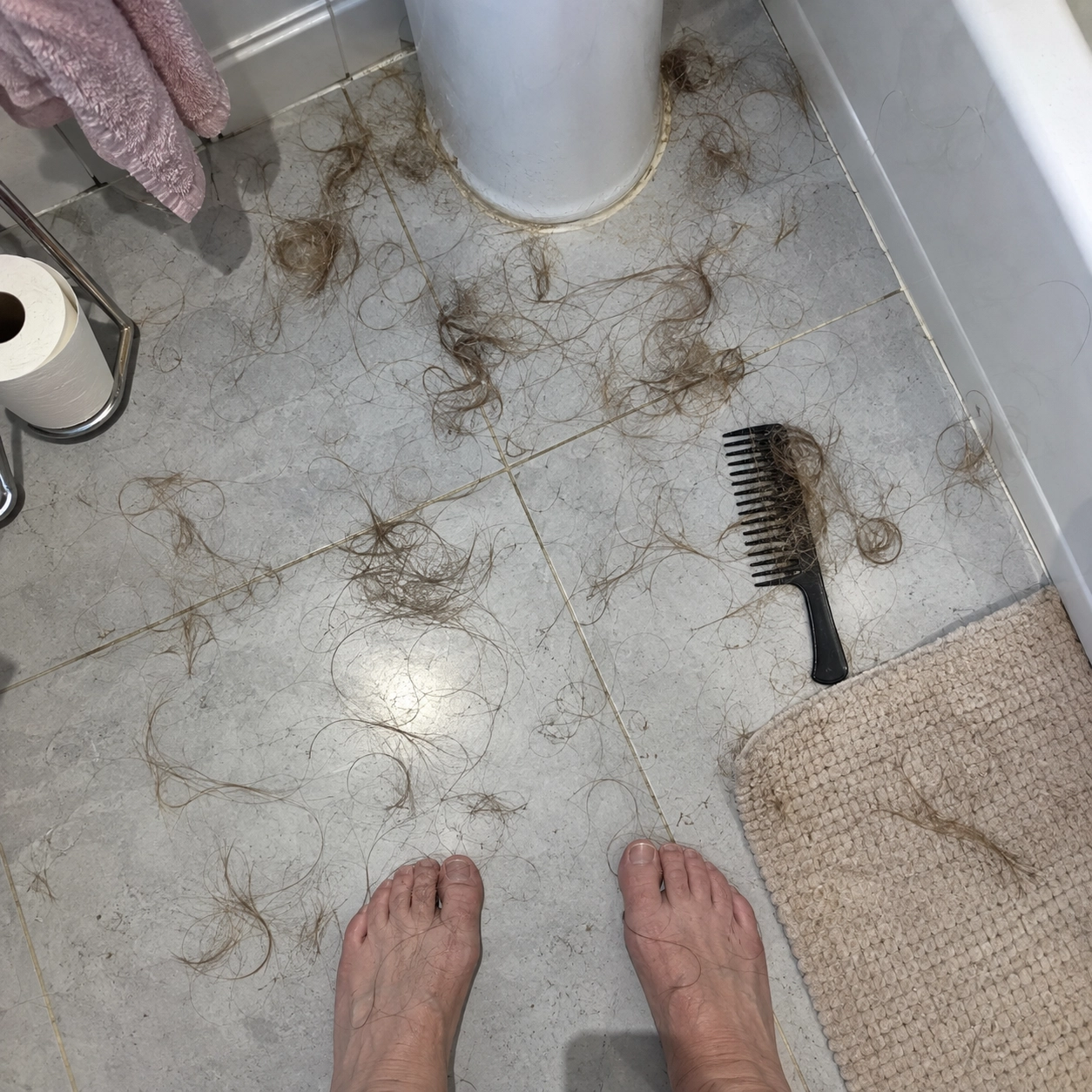
"I'm getting handfuls in the shower."

Then, a little later: "My parting's getting wider. I can see my scalp under the bathroom light." And almost always, said quietly, looking at the floor: "My ponytail's about the size of a pencil now."

If any of that is you, I want to say something before we go any further.

You are not imagining it. You are not being vain. And if a GP, a hairdresser or a partner has told you it's "just your age" — I'm sorry. I said that myself, for years, because it's what we were taught. I was wrong.

Below are the five things I now explain to every woman who sits in that chair. The first two are about why it's happening. The third is about why everything on the Boots shelf has failed you. The last two are about what actually reaches the problem — and they changed what I recommend.
5 Reasons Your Hair Has Been Thinning Since the Menopause and Why Nothing You've Bought Has Touched It
It isn't your hair that's failing. It's the follicle underneath it and oestrogen was holding it up.
1
It isn't your hair that's failing. It's the follicle underneath it and oestrogen was holding it up.
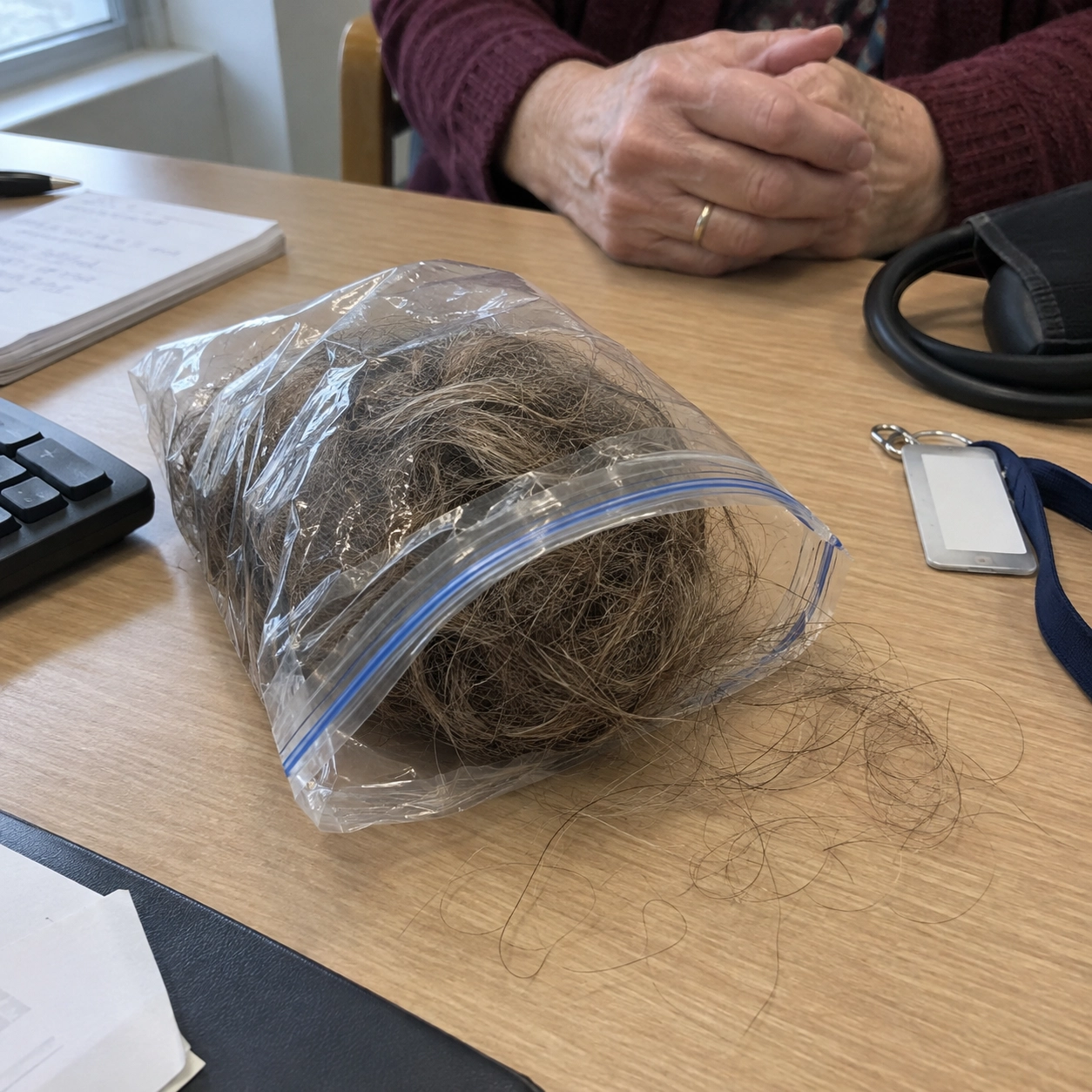
A patient I'll call Helen, 52, brought a sandwich bag to her appointment. It was full of hair from one week of showers. Her hairdresser had told her she was "over-washing".

She wasn't. Here is what was actually happening under her scalp.

Every hair on your head grows from a follicle, and every follicle runs a cycle: a growing phase that lasts years, a short resting phase, then the hair falls and a new one starts. For most of your adult life, oestrogen has been quietly doing one job in that cycle  keeping follicles in the growing phase for longer. The follicle has oestrogen receptors of its own; it's a direct target for the hormone, not a bystander (Ohnemus et al., Endocrine Reviews, 2006).

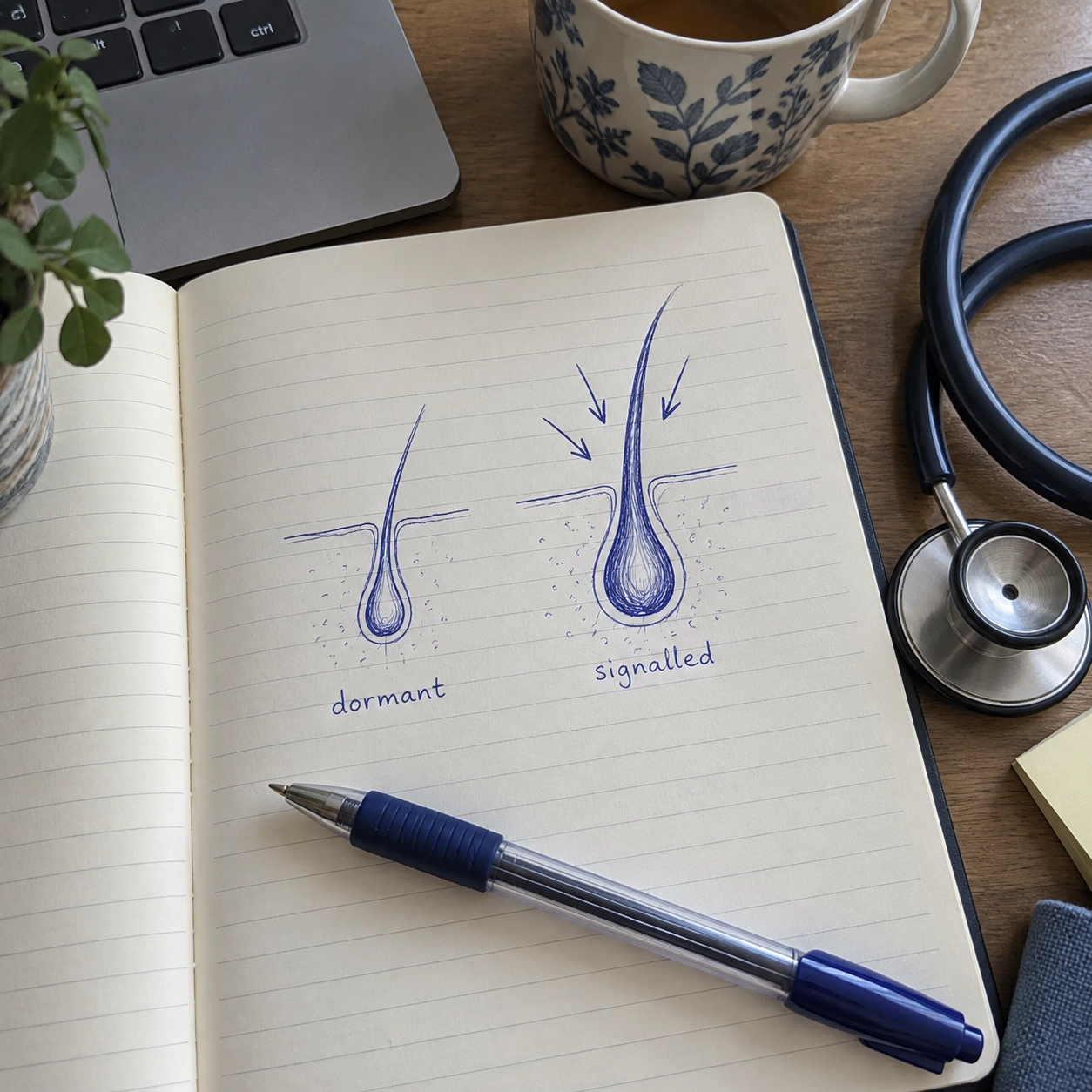
Oestrogen doesn't taper off politely when the menopause hits. It falls hard, and it keeps falling. When that signal weakens, more follicles drop out of the growing phase early. That's the shedding. But the part nobody explains is what happens next: each time a follicle restarts without that support, it comes back slightly smaller. The hair it makes is finer, shorter, paler. Dermatologists call it miniaturisation.

That's why you're seeing two things at once  hair in the drain and a parting you can see through. It isn't damage. It's follicles shrinking, one cycle at a time.

Helen's hair wasn't over-washed. It was under-signalled.

And here's the frustrating part: none of this shows up on a blood test  even when someone bothers to run one.
2
"Your bloods are normal" is not the same as "your follicles are fine".
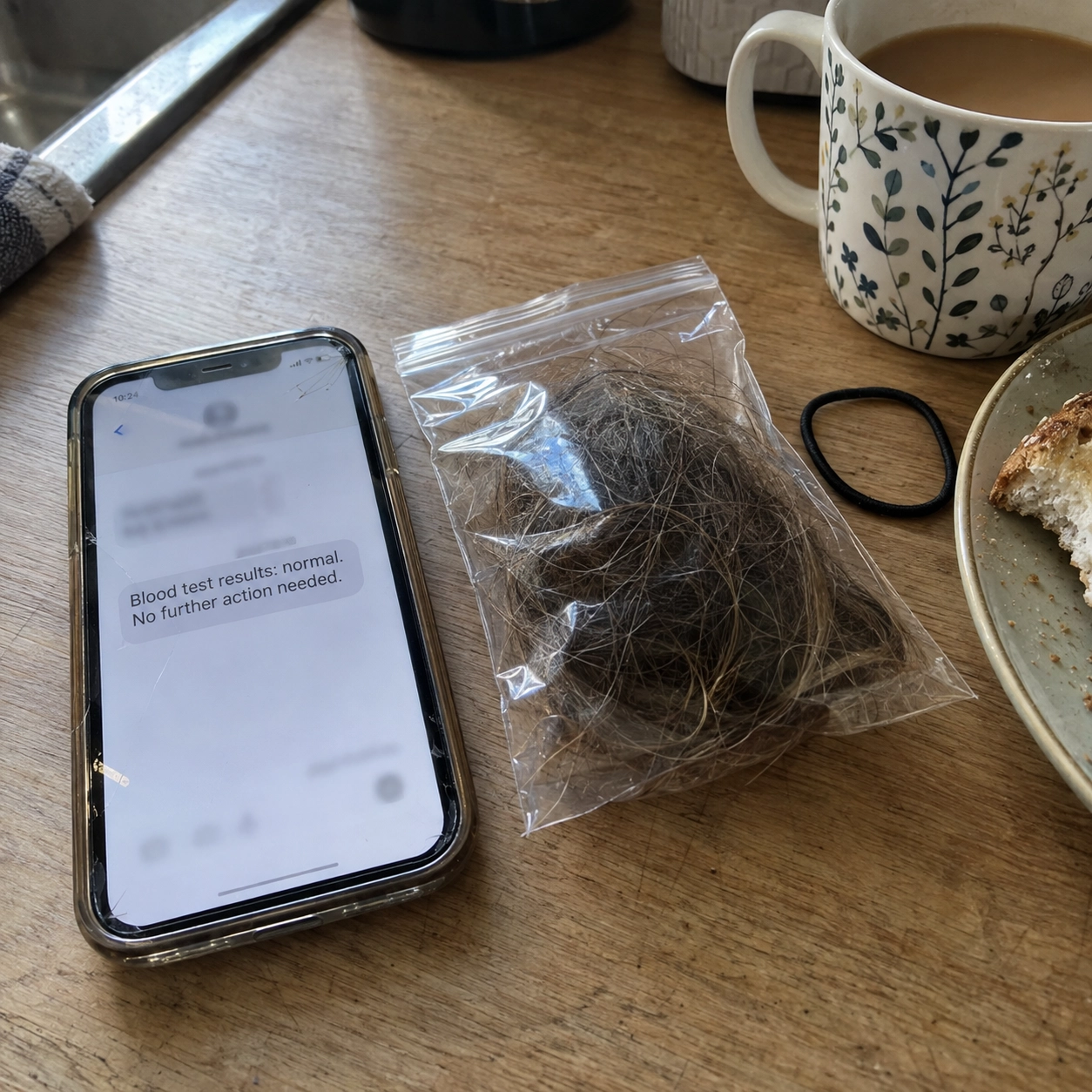
Helen had been to her GP. Bloods done. Everything "normal". Sent away.

I looked at the same results and saw three things that were making Reason 1 worse.

Her ferritin was 31. The lab range said normal. The hair-loss literature says otherwise: the threshold repeatedly recommended for women with hair shedding is a ferritin of at least 70 ng/mL (Trost, Bergfeld & Calogeras, Journal of the American Academy of Dermatology, 2006). Perimenopause is exactly when ferritin collapses — the heavy, unpredictable periods of your mid-forties drain iron faster than you replace it. At 31, her follicles were being told there wasn't enough iron to justify growing hair.

Only her TSH had been checked. That's the standard panel. It misses a lot. In one of the largest thyroid-screening studies ever run, roughly 1 in 10 adults had an undetected thyroid abnormality  more common in women, and rising with age (Canaris et al., Archives of Internal Medicine, 2000). A sluggish thyroid slows every follicle's cycle. The tell-tale signs are the ones women describe to me as "straw-like" hair and eyebrows thinning from the outer ends.

She was waking at 3 am, every night. Night sweats, then lying there. Chronic broken sleep keeps cortisol high, and sustained stress is one of the best-documented triggers for pushing follicles into their resting phase en masse  what we call telogen effluvium (Peters et al., American Journal of Pathology, 2006). Then the stress of losing your hair drives the cortisol higher. It's a loop.

So: three separate brakes on the follicle, and a results sheet that said "normal" on every line.

If you take one practical thing from this article: ask your GP for a ferritin level and a full thyroid panel, and say the words "hair loss" when you ask. It's free. Do it.

But correcting all of that takes months  and for some women the hair doesn't fully come back on its own. Which is why, in the meantime, they buy things. And this is where it goes wrong.
Everything on the shelf works on hair that is already dead.
3
Everything on the shelf works on hair that is already dead.
The strand of hair you can see and touch is dead keratin. It left the follicle finished. Nothing you put on it can change what the follicle does next.

That single fact explains most of the disappointment in my consulting room.

Thickening shampoos and masks coat the strand so it feels fatter for a wash or two. They do nothing underneath.

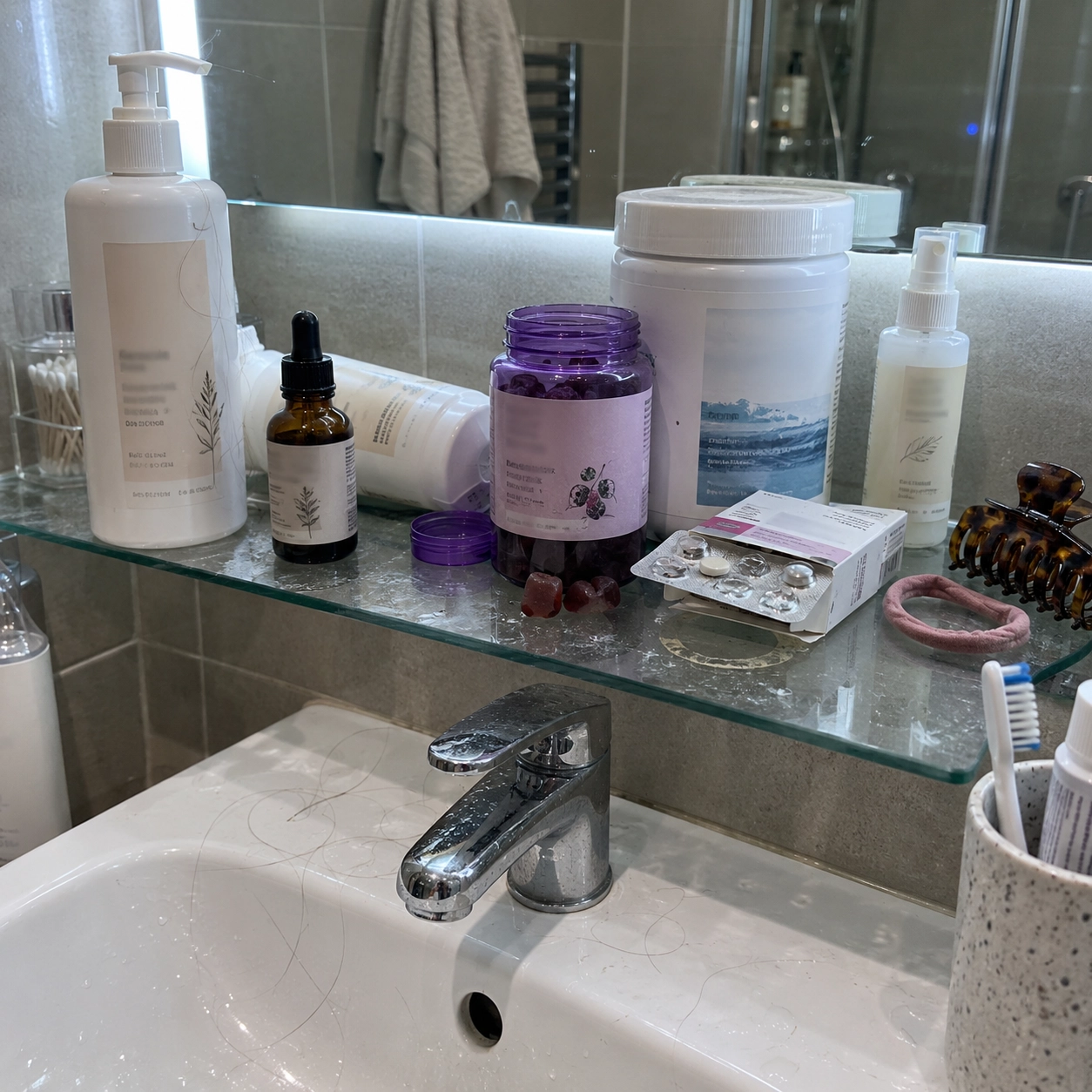
Biotin. True biotin deficiency is rare, and the evidence for biotin improving hair in women who aren't deficient is, to put it kindly, thin (Patel et al., Skin Appendage Disorders, 2017). It's a very popular way to spend £12 at Boots.

Rosemary oil. There is one small study, from 2015, in men, comparing it to minoxidil. That's the whole evidence base for the thousands of TikTok videos.

Oral iron. Useful if your ferritin is low  but slow, hard on the stomach, and it does nothing for the oestrogen problem in Reason 1.

None of these are scams. They're just aimed at the wrong place. You've been buying things for the hair, when the thing that's failing is the follicle.

So the question I ended up asking was simpler than I expected: can a follicle that has gone quiet be told to start again? It turns out it can  and the research came from a surprising place.
A quiet follicle can be signalled back into work with peptides and PDRN.
4
A quiet follicle can be signalled back into work  with peptides and PDRN.
A miniaturised follicle isn't dead. It's dormant. Small, under-instructed, but still there. And cells that are still there can still receive instructions.

Two categories of ingredient do exactly that.

Peptides are short chains of amino acids that act as messengers. Skin cells recognise them and respond — certain peptides, copper peptides in particular, have been studied for their ability to stimulate follicle activity and improve the tissue around it. They don't feed the hair. They talk to the cells that make it.

PDRN  polydeoxyribonucleotide  is a fragment of DNA, originally derived from salmon, that has been used for years in Korean and Italian regenerative medicine to speed up tissue repair. More recently it's been studied on the scalp, for the same reason: it encourages the cellular activity a dormant follicle has stopped doing on its own.

I'll be honest that this research is younger than I'd like. But it's the first category of ingredient I've seen that goes at the actual problem from Reason 1 — the follicle's signalling  instead of dressing the symptom.

There was a catch, though. And it's the reason most "peptide serums" in Boots do nothing either.
The best ingredient in the world is useless if it stays on your hair.
5
The best ingredient in the world is useless if it stays on your hair.
Your scalp is a barrier. That's its job: keep things out. The outer layer is built to stop anything reaching the follicle underneath.

Now think about how you apply a serum. A few drops on your fingertips, then you rub. Most of it coats the lengths  dead hair, Reason 3. Some evaporates. The rest ends up on your pillowcase. The follicle you were aiming at gets a trace, if that.

Clinics solve this with micro-needling: a roller of tiny needles that opens temporary micro-channels in the scalp so active ingredients can actually get in. It works  studies on micro-needling plus a topical show meaningfully better results than the topical alone. It also hurts, draws blood, and costs £150–£300 a session.

So what I wanted for my patients was two things:

1. Something that parts the hair and puts the product on the scalp not on the lengths.
2. Something that opens micro-channels without needles, blood or a clinic appointment.

Peptides and PDRN, delivered into the scalp, at home, in a couple of minutes.

For about a year, I couldn't find it.

What I now recommend

Then a patient came back for a follow-up with a tube in her bag, and asked me what I thought of it.

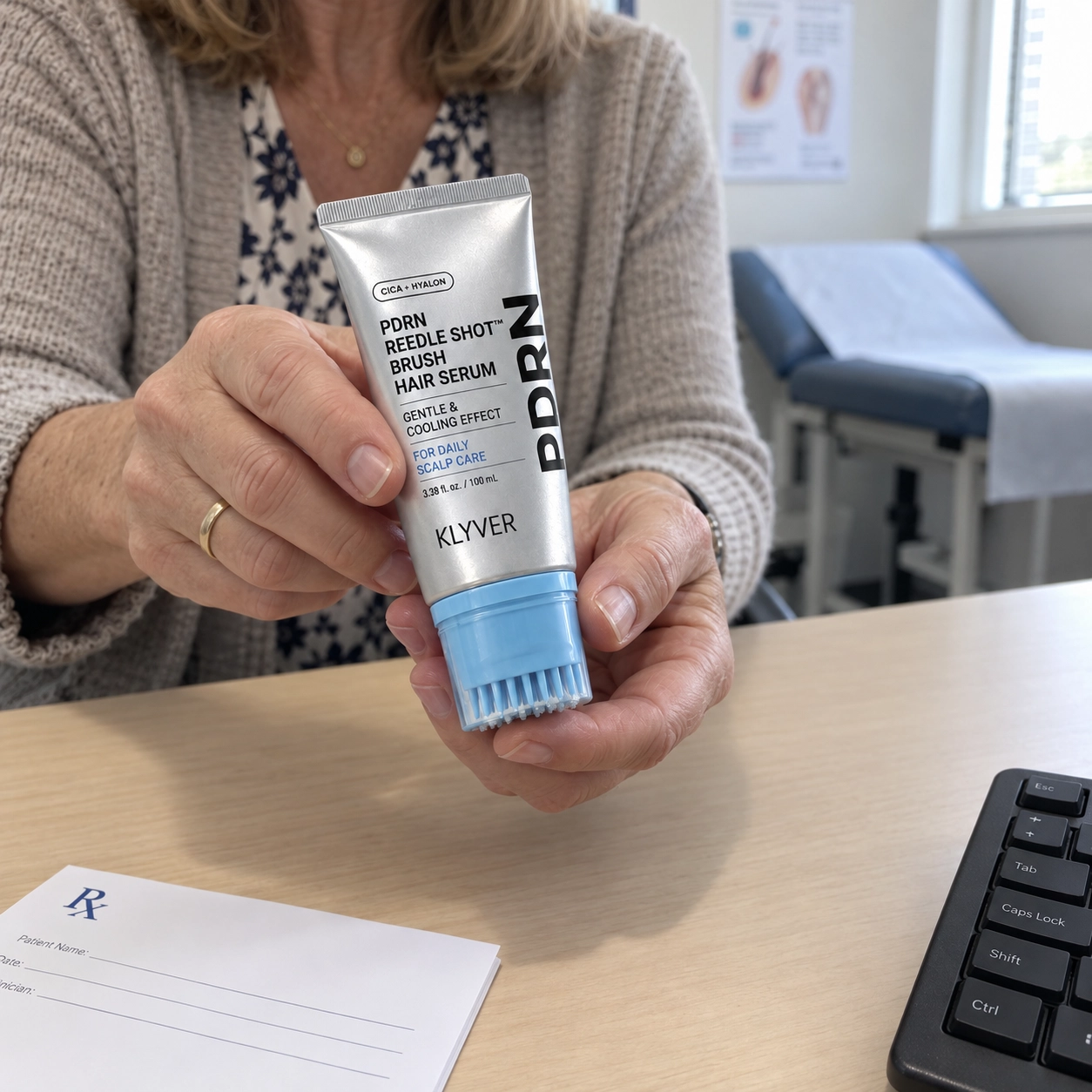
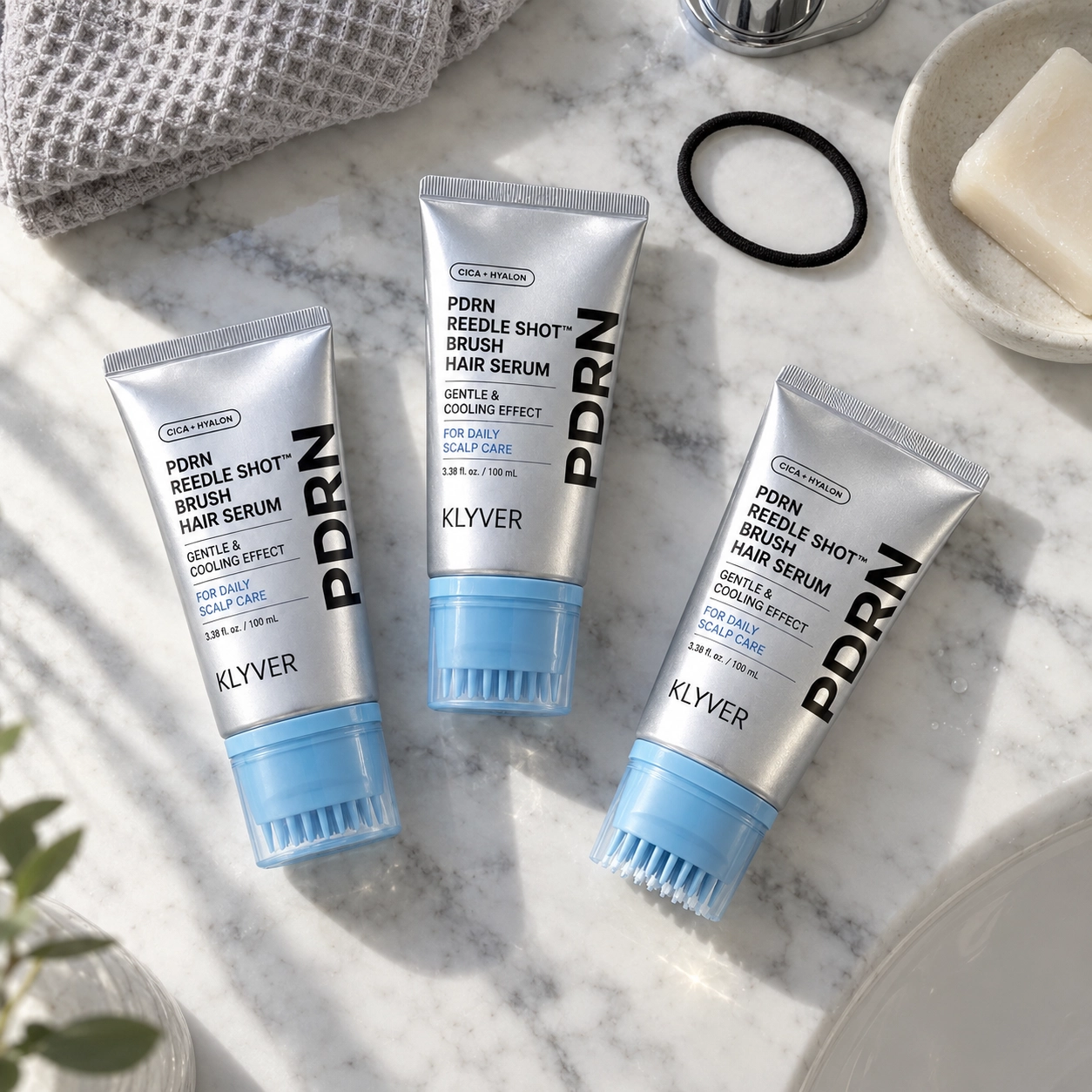
It was a PDRN and peptide serum applied through a brush head. Thirty-eight bristles part the hair and place the serum directly on the scalp. And the serum itself contains what the manufacturer calls "reedle shot"  microscopic mineral spicules, derived from marine sponge, that create temporary micro-channels on contact. Cold, tingling for about a minute, then absorbed. No needles. No blood. Two minutes a day.

That's Klyver. It's what I'd been describing above without knowing it existed.

In the order this article has laid out:

— Peptides and PDRN signal the dormant follicle (Reason 4)
— The brush puts them on the scalp, not the dead hair (Reason 5)
— The spicules carry them through the barrier — the manufacturer's data puts uptake at roughly ten times that of fingertip application

I won't tell you it works for every woman. Here's what I do tell my patients: a full hair cycle takes time, so give it 8 to 12 weeks, and photograph your parting on day one so you have something honest to compare against.
5 stars
4.8/5 from 10,200+ reviews
What my patients tell me
Different women, different timelines. I've left their words as they wrote them.
Week 12Parting
5 stars
When I hit 52 my parting started widening every month. I could see my scalp glowing through under the bathroom light. My GP said it was "just menopausal thinning, deal with it", which was about as helpful as it sounds. Thickening shampoo, biotin, rosemary oil  nothing. I'd more or less given up. Klyver was different straight away: you feel it on the scalp, cold and prickly, then it's gone. Took a photo on day one like Dr Jenkins said. 12 weeks in and my parting is closing. My mornings don't start with panic any more. xx
Deborah M., 54, Reading Verified Purchase
Week 9Shedding
5 stars
Brush finally clear. Week 9. Not a miracle  still thinner than I was at 40 but it's the first thing that's done anything, and my stomach thanks me for coming off the iron tablets.
Linda S., 49 Verified Purchase
Week 14Thyroid
5 stars
Diagnosed with a slow thyroid at 53, right when the menopause hit. Hair went straw-like almost overnight and my eyebrows thinned from the outer ends  exactly what this article describes, which is why I read all of it. I'm on levothyroxine but the hair didn't come back with it. I'll be straight: the first six weeks I saw nothing and nearly stopped. By week 14 the texture changed first — not brittle any more — and the top is fuller. Temples still thin. But it's mine again.
Elaine R., 56, Sheffield
Week 10Crown
5 stars
I was sceptical about the "micro-needling brush" thing. I'd been burned by enough gimmicks by 52. But you can actualy feel it working from the first application  tingling, then absorbed. In 10 weeks my crown looks thicker than it has in years. I finally look like myself in the mirror.
Karen V., 52 Verified Purchase
Why three tubes, not one
One tube is four weeks. I've just told you a hair cycle needs eight to twelve. That's why the offer is built the way it is: Buy 2, Get 1 Free is one full 12-week course  not a gimmick, the minimum I'd ask any patient to commit to before judging it.

Free UK Delivery  Royal Mail Tracked 48, dispatched next working day.

The 60-Day Guarantee if by week 8 your parting hasn't changed, email them, get a full refund, keep the tube. No photos, no forms.

Take the photo of your parting today. Then start
CheckCircle
Buy 2, Get 1 Free  one full 12-week course
CheckCircle
Free UK Delivery —Royal Mail Tracked 48
CheckCircle
60-Day Guarantee · 4.8/5 from 10,200+ reviews
Why three tubes, not one